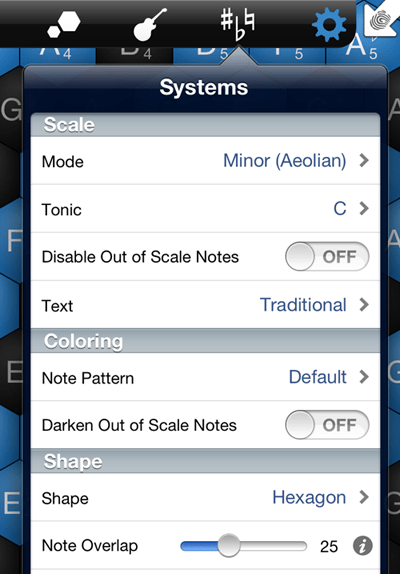
Musix Pro comes bundled with a set of pre-fab layouts which includes several of the more popular isomorphic layouts as well as two we designed as part of the development of the app. In addition, we are including more layouts at no extra cost, but we are not providing detailed pattern sets for those keyboards. Each layout has its strengths and weaknesses, and we encourage you to try them all and find one that works for you.
Included Layouts and Their Definitions
Click on a layout name for more information:- Gerhard (- Maj. 3rd; + Min. 3rd; Vertical) Designed specifically for the iPhone/iPad and Musix Pro, this layout attempts to balance the advantages and disadvantages of other layouts listed below. Scales are tight and chords fit naturally on the fingers.
- Park (- Min. 3rd; + Maj. 2nd; Horizontal) A variation on the Wicki-Hayden (listed below), this layout, white notes are together making patterns easier to see, and scales can be played by sliding fingers along the screen. Alternate and jazz chords are compact, which means this pattern sounds great when button mashing.
- Maupin
- Wicki-Hayden (- Perf. 4th; - Perf 5th; Horizontal) This is the classic layout used for centuries on Accordions and Concertinas. White notes are together, and the I-IV-V pattern of many many songs forms a compact triangle. Scales play linearly left-to-right (like a piano) with jumps for each semitone. Whole-tine scales are linear. Simple chords are comfortable, more complex chords are more challenging. This is also the preferred layout for "jammer" instruments.
- Harmonic (- Maj. 3rd; - Min 3rd; Horizontal) Also called the Harmonic Table, this relatively modern layout was developed and popularized by C-Thru Music, the makers of the excellent Axis line of isomorphic MIDI keyboards. The harmonic table provides impossibly easy chords, with major and minor triads in triangles playable with a single finger. Scales are somewhat cumbersome, but as with all layouts, once learned in one key, all other keys are the same pattern.
- Janko
- C-System
- B-System
- Bajan
- LinnStrument
Note Overlap
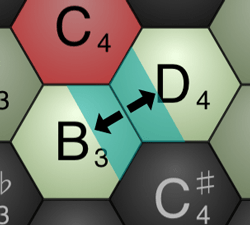
The note overlap attribute describes the overlap area on a key in which the neighbouring key can be played simultaneously with one touch. A low overlap value will result in a small overlapping area. Likewise a high overlap value will result in a larger overlapping area.